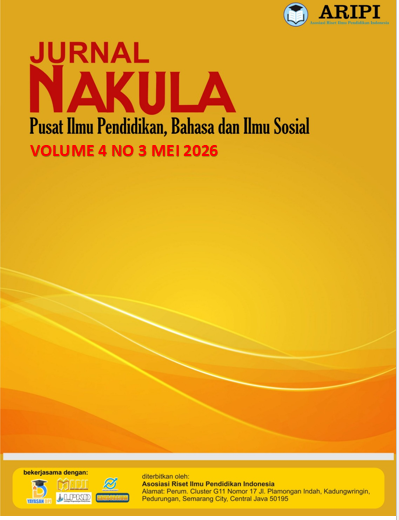
Analisis Kasus Hoaks di Kalangan Pelajar Sebagai Tantangan Literasi Digital dalam Dunia Pendidikan
DOI:
https://doi.org/10.61132/nakula.v4i3.2800Keywords:
Digital Literacy, Education, Hoaxes, Social Media, StudentsAbstract
This study discusses the phenomenon of hoaxes among students as one of the challenges to digital literacy in the education sector. The rapid growth of digital technology and social media has made information easier for students to access. However, this development also increases the spread of false information and hoaxes among young people. This research used a qualitative approach whit a literature study method by riviewing various publications related to digital literacy and misinformation. The findings show that the apread of hoaxes among students is caused by several factors, such as limited digital literacy skills, emotional influences, social enviroments, technological developments. And weak critical thingking abilities. In addition, social media algorithms and digital culture also play an important role in accelerating the spread of misleading information. Therefore, strengthening digital literacy is considered important as a preventive effort, especially through improving critical thingking skills, information verification abilities, and ethical awareness ehwn using digital media. The study concludes that cooperation between schools, families, government, and socienty is necessary to improve students’ digital literacy skills so that the spread of hoaxes in the digital era can be reduced.
Downloads
References
Alton Grizzle, Carolyn Wilson, Ramon Tuazon, C.K. Cheung, J., Lau, Rachel Fischer, Dorothy Gordon, Kwame Akyempong, J., Singh, Paul R. Carr, Kristine Stewart, Samy Tayie, O. S., Maarit Jaakkola, Gina Thésée, Curmira Gu, A. M., & Blaise Pascal, Z. F. P. A. (2021). Literate Citizens Think Critically , Click Wisely.
Chigbu, U. E., Atiku, S. O., & Du Plessis, C. C. (2023). The Science of Literature Reviews: Searching, Identifying, Selecting, and Synthesising. Publications, 11(1). https://doi.org/10.3390/publications11010002
Effendi, E. (2023). User behaviour and hoax information on social media case of Indonesia. Jurnal Studi Komunikasi (Indonesian Journal of Communications Studies), 7(3), 930–943. https://doi.org/10.25139/jsk.v7i3.7402
Fathoni, M. I., Widyaningsih, N., Saputra, G. A., Nashrulloh, A. R., & Saputri, A. W. (2023). Kemampuan Literasi Digital dan Self-Directed Learning dalam Perspektif Siswa SMK Negeri 7 Yogyakarta. Epistema, 4(2), 96–109. https://doi.org/10.21831/ep.v4i1.61764
Fauzi, M. (2021). Pengaruh Literasi Digital Terhadap Pencegahan Informasi Hoaks pada Remaja di SMA Negeri 7 Kota Lhokseumawe. Jurnal Pekommas, 6(2), 77–84. https://doi.org/10.30818/jpkm.2021.2060210
Ghanem, B., Rosso, P., & Rangel, F. (2020). An Emotional Analysis of False Information in Social Media and News Articles. ACM Transactions on Internet Technology, 20(2), 1–17. https://doi.org/10.1145/3381750
Hameleers, M. (2023). Disinformation as a context-bound phenomenon: toward a conceptual clarification integrating actors, intentions and techniques of creation and dissemination. Communication Theory, 33(1), 1–10. https://doi.org/10.1093/ct/qtac021
Hameleers, M., & van der Meer, T. (2023). Striking the balance between fake and real: under what conditions can media literacy messages that warn about misinformation maintain trust in accurate information? Behaviour and Information Technology, 3001, 1209–1221. https://doi.org/10.1080/0144929X.2023.2267700
Husaeni, A. S., Hidayat, R., & Khadijah, I. (2023). Peran Literasi Digital terhadap Kemampuan Berpikir Kritis Siswa pada Mata Pelajaran Bahasa Indonesia Kelas V MI. JIIP - Jurnal Ilmiah Ilmu Pendidikan, 6(11), 8913–8918. https://doi.org/10.54371/jiip.v6i11.2697
Kumar, S., & Shah, N. (2018). False Information on Web and Social Media: A Survey. 1(1). http://arxiv.org/abs/1804.08559
Kusnadi, E., Supriyadi, D., Rahmani, N., & Saepul, Z. (2026). Pengaruh Proyek Literasi Media Sosial dalam Pembelajaran PPKn terhadap Peningkatan Kemampuan Berpikir Kritis. 17(1), 116–130.
Lutfi Cahya Kurniawan, & Wahyuni, I. (2023). Studi Literatur : Pemahaman Matematis Siswa Dalam Menyelesaiakan Soal Matematika Pada Materi Himpunan. Indonesian Journal of Science, Technology and Humanities, 1(1), 45–52. https://doi.org/10.60076/ijstech.v1i1.10
Mujianto, H., & Nurhadi, Z. F. (2022). Dampak Literasi Media Berbasis Digital Terhadap Perilaku Anti Penyebaran Hoaks. Alhadharah: Jurnal Ilmu Dakwah, 21(1), 31. https://doi.org/10.18592/alhadharah.v21i1.6419
Penerapan, J., Informasi, T., Hoaks, I., Smk, D. I., Bisnis, K., & Salatiga, M. (2023). IT-EXPLORE. 02, 232–246.
Potter, W. J. (2022). Analysis of definitions of media literacy. Journal of Media Literacy Education, 14(2), 27–43. https://doi.org/10.23860/JMLE-2022-14-2-3
Raharjo, N. P., & Winarko, B. (2021). Analisis Tingkat Literasi Digital Generasi Milenial Kota Surabaya dalam Menanggulangi Penyebaran Hoaks. Jurnal Komunika: Jurnal Komunikasi, Media Dan Informatika, 10(1), 33. https://doi.org/10.31504/komunika.v10i1.3795
Shen, Y., Liu, Q., Guo, N., Yuan, J., & Yang, Y. (2023). Fake News Detection on Social Networks: A Survey. Applied Sciences (Switzerland), 13(21), 1–19. https://doi.org/10.3390/app132111877
Shu, K., Bhattacharjee, A., Alatawi, F., Nazer, T. H., Ding, K., Karami, M., & Liu, H. (2020). Combating disinformation in a social media age. Wiley Interdisciplinary Reviews: Data Mining and Knowledge Discovery, 10(6), 1–39. https://doi.org/10.1002/widm.1385
Sri Astuti Iriyani, Milla, D., Lede, Y. K., & Kholidi. (2023). Perkembangan Literasi Digital dalam Pendidikan: Sebuah Tinjauan Bibliometrik. Indo-MathEdu Intellectuals Journal, 4(2), 1289–1301. https://doi.org/10.54373/imeij.v4i2.349
Thomas, P. B., Hogan-Taylor, C., Yankoski, M., & Weninger, T. (2022). Pilot study suggests online media literacy programming reduces belief in false news in Indonesia. First Monday, 27(1), 1–13. https://doi.org/10.5210/fm.v27i1.11683
Downloads
Published
How to Cite
Issue
Section
License
Copyright (c) 2026 Jurnal Nakula : Pusat Ilmu Pendidikan, Bahasa dan Ilmu Sosial

This work is licensed under a Creative Commons Attribution-ShareAlike 4.0 International License.