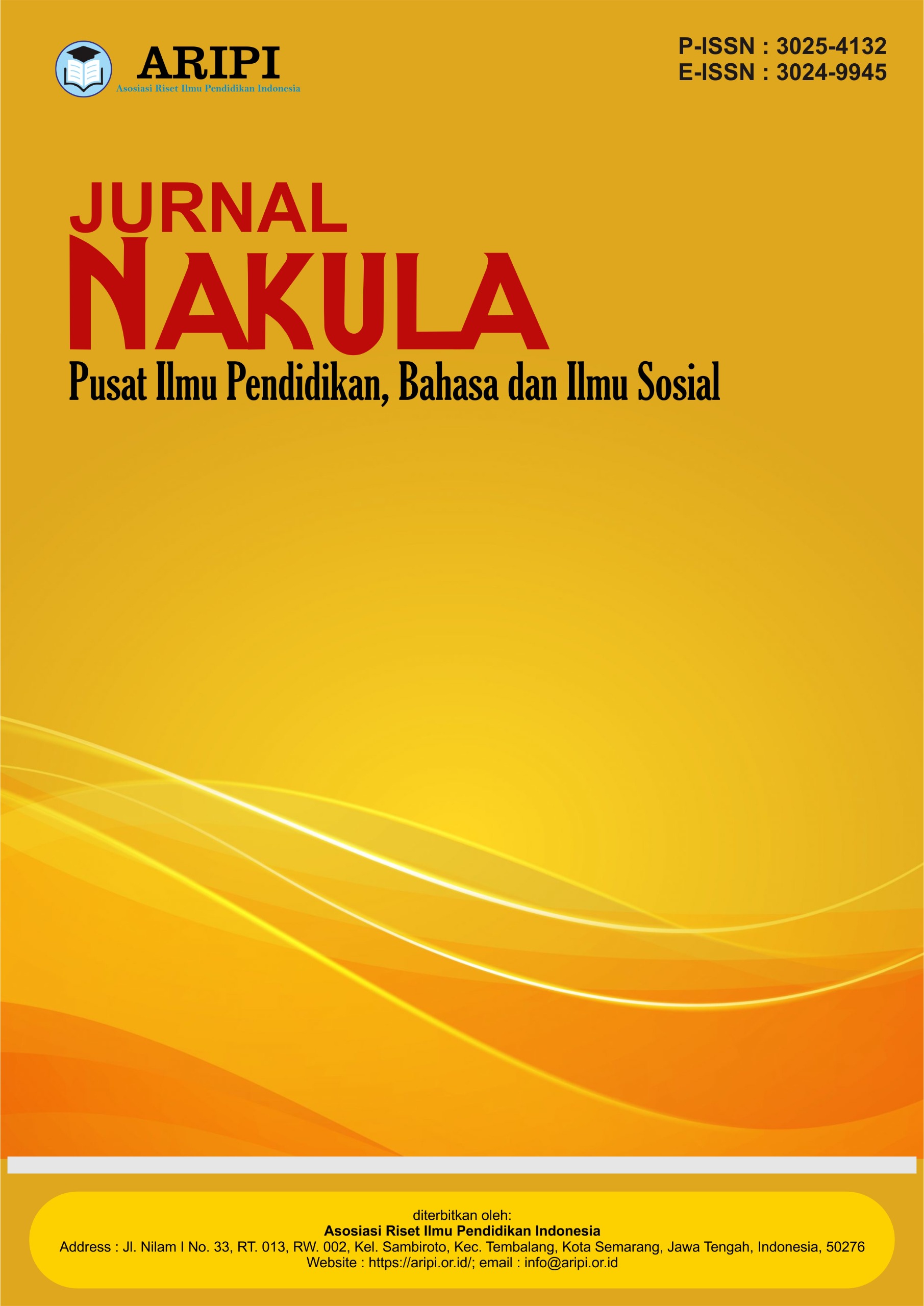
Neologisms in Popular Culture: A Review of Linguistic Innovation
DOI:
https://doi.org/10.61132/nakula.v4i2.2862Keywords:
Digital Communication, Kreativitas Linguistics, Language Neologism, Popular Culture, Social MediaAbstract
Neologism refer to creation of new word or expression in language plus are widely recognized as important part of language development together with cultural change. This article reviews emergence of new vocabulary in popular culture as well as shows that popular culture provide dynamic environment for linguistic creativity. It examines study discussing neologism that originate from film, especially blockbuster movie, television series, music, along with social media. These study demonstrate important role of popular culture in introducing new expression into language plus spreading them to wider audience. Although many scholars have examined neologism, only limited number have explored popular culture as broad together with interconnected domain. Popular culture include music, film, television program, video game, social media, internet trend, in addition to other cultural activity that influence everyday life. In recent year, it become major source of new vocabulary, continuously producing modern plus widely used expression. This study apply qualitative library research approach through systematic review of literature obtained from journal, book, along with academic database. Finding indicate that popular culture plays major role in accelerating spread together with acceptance of neologism, particularly through digital communication. In addition, social media platform as well as entertainment industry serve as important channel for introducing new term, contributing to language development, identity formation, plus intercultural communication in modern society.
Downloads
References
Adams, D., Smith, J., & Carter, P. (2024). The role of visual feedback and modeling in motor skill acquisition: A systematic review. Journal of Motor Learning and Development, 12(1), 45–62. https://doi.org/10.1123/jmld.2024-0012
Anggraini, D., Prasetyo, Y., & Kurniawan, A. (2024). The effect of demonstration methods on basketball free throw accuracy among students. International Journal of Educational Development, 8(2), 101–110. https://doi.org/10.1234/ijed.v8i2.49
Babbie, E. (2021). The practice of social research (15th ed.). Cengage.
Cohen, J., Cohen, P., West, S. G., & Aiken, L. S. (2020). Applied multiple regression/correlation analysis for the behavioral sciences (3rd ed.). Routledge.
Capilla Martín, M. (2023). Social media as a research tool in neology. CLINA: An Interdisciplinary Journal of Translation, Interpreting and Intercultural Communication, 9(1), 33–53. https://doi.org/10.14201/clina2023913353
Crystal, D. (2023). Language and the Internet (3rd ed.). Cambridge University Press.
Fandrych, C., & Thurmair, M. (2022). Neologisms and language change in digital communication. Lexis, 20, 1–18.
Field, A. (2020). Discovering statistics using IBM SPSS statistics (5th ed.). Sage.
Field, A., Miles, J., & Field, Z. (2021). Discovering statistics using R (2nd ed.). Sage.
Gravetter, F. J., & Wallnau, L. B. (2021). Statistics for the behavioral sciences (11th ed.). Cengage.
Guadagnoli, M. A., Holcomb, W. R., & Davis, D. (2021). Motor learning and observational practice in sports: Effects on skill acquisition and retention. Journal of Sports Sciences, 39(14), 1623–1633.
He, Y., & Wei, X. (2025). Augmented reality-based feedback and its impact on motor skill learning and motivation in physical education. Frontiers in Psychology, 16, 1162193. https://doi.org/10.3389/fpsyg.2025.1162193
Hopkins, W. G. (2021). Design and analysis of research studies in sport science. Sports Science Press.
Huang, C., Wang, T., & Chen, Y. (2021). Assessment of free throw accuracy in basketball: Reliability and validity study. Journal of Sports Sciences, 39(12), 1350–1358.
Humbert-Droz, J. (2023). When terms become neologisms: A contribution to the study of neology from the perspective of determinologisation. CLINA: An Interdisciplinary Journal of Translation, Interpreting and Intercultural Communication, 9(1), 135–158. https://doi.org/10.14201/clina202391135158
Ivanov, A., Nikonova, Z., Frolova, N., & Muratbayeva, I. (2023). Linguistic potential of COVID-19 neologisms in the metaphoric language of socio-political discourse. Communication and the Public, 8(3), 237–253. https://doi.org/10.1177/20570473231186475
Keetch, K. M., & Reed, M. P. (2020). Experimental designs in sport and exercise science research. Journal of Sports Science & Medicine, 19(4), 603–612.
Krajenbrink, H., van der Kamp, J., & Savelsbergh, G. J. P. (2021). Motor skill acquisition and retention: An applied study on sports learning. International Journal of Environmental Research and Public Health, 18(9), 4563.
Kerremans, D. (2023). A web of new words: Neology, technology and language change. Cambridge University Press.
Llopart-Saumell, E., & Cañete-González, P. (2023). Are stylistic neologisms more neological? A corpus-based study of lexical innovations of women and men. Languages, 8(3), 175. https://doi.org/10.3390/languages8030175
Laerd Statistics. (2021). Independent t-test in SPSS statistics. Laerd Statistics.
Moradi, M., Saberi, K., & Zarghami, M. (2026). Self-controlled versus instructor-controlled modeling on motor learning and retention in basketball free throw. Journal of Motor Behavior, 58(1), 1–10. https://doi.org/10.1080/00222895.2026.2615718
Newell, K. M., & Liu, Y. T. (2022). Motor learning and retention: A systems perspective. Human Movement Science, 82, 102997.
Oliva-Sanz, C. (2023). Spreading of neological terms related to pandemics in Spanish and British newspapers: A contrastive analysis. CLINA: An Interdisciplinary Journal of Translation, Interpreting and Intercultural Communication, 9(1), 13–31. https://doi.org/10.14201/clina2023911331
Oxford Languages. (2024). Oxford languages updates and new words reports. Oxford University Press.
Pentzold, C., & Knorr, C. (2024). When data became big: Revisiting the rise of an obsolete keyword. Information, Communication & Society, 27(3), 600–617. https://doi.org/10.1080/1369118X.2023.2227673
Pallant, J. (2020). SPSS survival manual: A step by step guide to data analysis using IBM SPSS (7th ed.). McGraw-Hill Education.
Qi, H., & Zhang, H. (2024). Characteristics of internet neologisms in Chinese networks in 2023. Modern Scientist, 7, 21–26. https://doi.org/10.58224/2541-8459-2024-7-21-26
Renouf, A. (2023). Neology and word formation in contemporary English. Routledge.
Roudometof, V. (2023). Digital glocalization: Theorizing the twenty-first-century ICT revolution. Frontiers in Communication, 8, Article 1244614. https://doi.org/10.3389/fcomm.2023.1244614
Snyder, H. (2019). Literature review as a research methodology: An overview and guidelines. Journal of Business Research, 104, 333–339. https://doi.org/10.1016/j.jbusres.2019.07.039
Ranganathan, R., & Newell, K. M. (2020). Changing constraints and skill development in dynamic tasks. Human Movement Science, 71, 102611.
Schmidt, R. A., & Lee, T. D. (2020). Motor control and learning: A behavioral emphasis (6th ed.). Human Kinetics.
Shadish, W. R., Cook, T. D., & Campbell, D. T. (2021). Experimental and quasi-experimental designs for generalized causal inference (2nd ed.). Cengage.
Suleiman, S. (2013). Learning theories and motor skill acquisition. Dar Al-Fikr.
Tenenbaum, G., Eklund, R. C., & Kamata, A. (2020). Measurement reliability in sport and exercise psychology. Journal of Applied Sport Psychology, 32(4), 351–370.
Thomas, J. R., Nelson, J. K., & Silverman, S. J. (2021). Research methods in physical activity (8th ed.). Human Kinetics.
Ueyama, Y., & Harada, T. (2024). Effects of error-based and reinforcement learning on motor skill acquisition and retention. Scientific Reports, 14, 51190. https://doi.org/10.1038/s41598-024-51190-9
Ueyama, Y., Fujii, S., & Harada, T. (2022). Differential effects of feedback types on motor learning and retention: Evidence from experimental studies. Scientific Reports, 12, 26568. https://doi.org/10.1038/s41598-022-26568-2
Wisniewski, B., Zierer, K., & Hattie, J. (2020). The influence of instructional strategies on motor learning: A meta-analytic review. Educational Psychology Review, 32, 1063–1088.
Wulf, G. (2021). Motor learning and performance: A task-oriented approach (6th ed.). Human Kinetics.
Wulf, G., & Lewthwaite, R. (2020). Optimizing performance through intrinsic motivation and attention for learning (OPTIMAL) theory of motor learning. Psychonomic Bulletin & Review, 27(2), 251–267.
Xiao, Y., & Watson, M. (2019). Guidance on conducting a systematic literature review. Journal of Planning Education and Research, 39(1), 93–112. https://doi.org/10.1177/0739456X17723971
Younus, M. (2025). The impact of feedback on motor skill performance in physical education: A comparative study. Journal of Physical Education Research, 15(1), 55–68.
Zhang, Y., & Liu, H. (2024). Social media and lexical innovation: The diffusion of neologisms in online discourse. Journal of Pragmatics, 228, 45–58.
Zhou, Z., Wang, Y., & Li, X. (2021). The role of feedback in motor skill learning: A meta-analysis study. Frontiers in Psychology, 12, 661432. https://doi.org/10.3389/fpsyg.2021.661432
Downloads
Published
How to Cite
Issue
Section
License
Copyright (c) 2026 Jurnal Nakula : Pusat Ilmu Pendidikan, Bahasa dan Ilmu Sosial

This work is licensed under a Creative Commons Attribution-ShareAlike 4.0 International License.